中 文
中 文

Inadequate Zirconia Drying: The Hidden Cause of Chipping, Cracking & Marginal Leakage – Root Cause Analysis & Fixes (2026 Guide)
2026-03-13
2026-08-31
Zirconia (ZrO₂) ceramics are widely employed in dental restorations and structural components owing to their high strength, fracture toughness, and excellent biocompatibility. Conventional sintering protocols typically require several hours, whereas the recently advanced "fast firing" (rapid sintering) technique compresses the cycle to tens of minutes while preserving—or even enhancing—the properties of the sintered body. This article systematically examines the technology from four perspectives: the underlying principles, powder-formulation differences, sintering-curve disparities, and the resulting differences in microstructure and properties.
Sintering is the process by which a ceramic compact attains pore closure and volumetric densification through mass transport between particles at elevated temperature. In the zirconia (ZrO₂) system, this process is invariably accompanied by grain growth. In the conventional view, densification and grain growth are regarded as inseparable phenomena sharing the same thermal history. The core principle of fast firing lies in exploiting the differential kinetic responses of the two processes to decouple densification from grain growth.
Specifically, surface diffusion dominates the early-to-intermediate temperature regime, producing only neck growth and particle rearrangement without eliminating bulk porosity—a state of "coarsening without densification." As the temperature rises sufficiently, grain-boundary diffusion and lattice (bulk) diffusion are activated and become the primary engines of densification, driving rapid pore shrinkage and closure. Grain growth, by contrast, is governed by the thermal budget (dwell time and peak temperature) and obeys the kinetic relationship Gn − G0n = Kt, rendering it highly sensitive to dwell time.
Fast firing is designed accordingly: an extremely high heating rate rapidly traverses the "critical temperature window" (≈200–900 °C, where surface diffusion dominates), preserving high surface energy until grain-boundary and lattice diffusion are activated; densification is then completed within a very short dwell, followed immediately by cooling that locks in the grain structure—thereby withholding the thermal budget required for grain growth.
The zirconia system also exhibits distinctive physico-chemical mechanisms: stabilizers such as yttria (Y₂O₃) lock in the high-temperature tetragonal phase (t-ZrO₂), conferring transformation toughening; the rapid thermal cycling induces oxygen vacancies that enhance ionic diffusion and lower the required sintering temperature; and minor second phases such as alumina (Al₂O₃) exert grain-boundary pinning (Zener pinning) that suppresses abnormal grain growth. Together, these mechanisms enable complete densification within a short thermal history without sacrificing properties.
In summary, the essence of fast firing is not merely raising the temperature, but decoupling densification from grain growth through process control—completing densification before grain growth can proceed.
The powder feedstock of fast-firing and conventional zirconia blocks shares the same base composition: a zirconia matrix with a yttria stabilizer (typically 3Y-TZP or 4Y-TZP). The difference lies in the targeted optimization of formulation and microstructure, rather than a fundamental substitution of the compositional system.
Fast-firing powders typically exhibit the following characteristics: (i) finer particle size, narrower size distribution, and reduced agglomeration (mostly nano- to sub-micron scale), yielding higher specific surface area and sinterability for rapid densification; (ii) optimized stabilizer content and distribution (e.g., 4 mol% yttria or a graded distribution) to withstand the severe thermal shock of fast firing; (iii) incorporation of a minor grain-boundary pinning agent (e.g., Al₂O₃) to prevent abnormal grain growth under short, high-temperature exposure; and (iv) a higher green density with fewer internal defects (large pores, impurities), since the fast-firing history provides insufficient time for "self-healing" of the compact.
A common misconception warrants clarification: the final grain size is not equivalent to the starting powder particle size. Grain growth is inevitable during sintering (through Ostwald ripening and grain-boundary migration), so the final grain size is the combined outcome of the initial particle size and the growth accrued during firing. Processing parameters (dwell duration and the presence or absence of pinning agents) dominate the final grain size, while powder fineness merely sets the starting point. In other words, the fine-grained character of fast-fired blocks arises from the synergy of "fine starting powder + short dwell (minimal growth) + pinning (suppressed growth)," not from a finer feedstock alone.
The simplistic view that a fast-firing block is merely "conventional powder plus alumina" overlooks the genuine technical barrier constituted by powder processing—uniform dispersion and a low-defect green body. Nanoscale particle size, monodispersity, and green-body homogeneity are achieved only through processes such as co-precipitation, hydrothermal synthesis, and spray granulation, which account for why fast-firing blocks are difficult to replicate by simple means.
Fast firing and conventional sintering exhibit systematic differences in their heating protocols—broadly characterized as "rapid firing" versus "slow firing." The following analysis uses the actual sintering curves of two zirconia blocks from our portfolio to illustrate the disparities stage by stage and the corresponding internal changes within the compact.
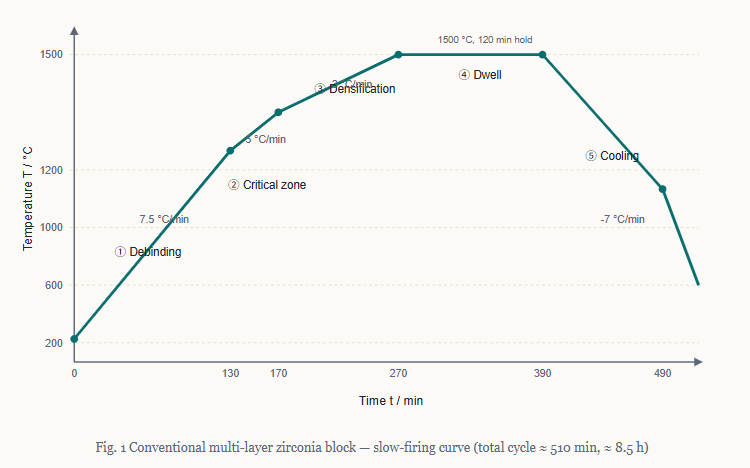
As shown in Fig. 1, the conventional block follows a six-segment protocol: heating from 20 °C to 1000 °C at 7.5 °C/min (≈130 min), then to 1200 °C at 5 °C/min (40 min), then to 1500 °C at 3 °C/min (100 min), holding at 1500 °C for 120 min, cooling to 800 °C at 7 °C/min (100 min), and finally natural cooling. The total cycle is ≈510 min (≈8.5 h).
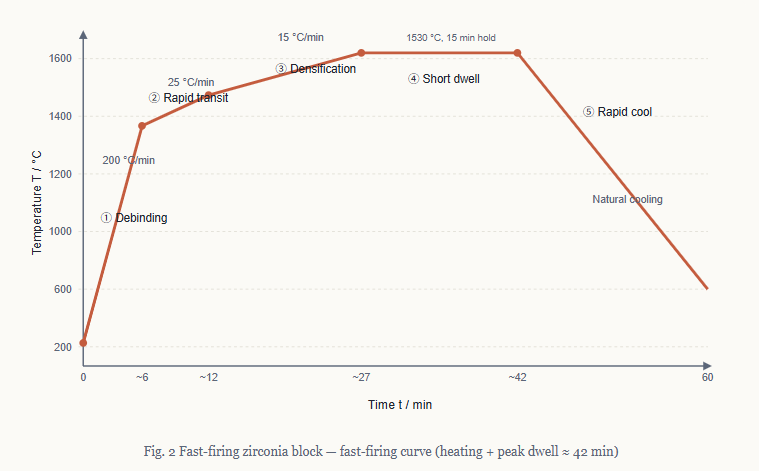
As shown in Fig. 2, the fast-firing protocol is: 20 °C to 1150 °C at 200 °C/min (≈6 min), then to 1310 °C at 25 °C/min (≈6 min), then to 1530 °C at 15 °C/min (≈15 min), holding at 1530 °C for only 15 min, followed by natural cooling. The heating and peak-dwell stages total ≈42 min—a roughly 12-fold reduction versus the 510 min conventional cycle.
Placing both curves within a common sintering-dynamics framework, the process can be divided into five corresponding stages with markedly different internal changes:
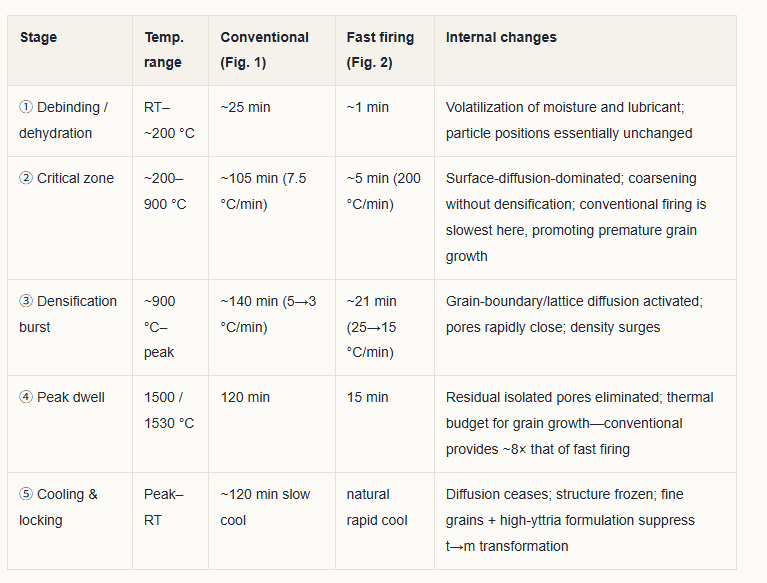
The critical differences concentrate in two segments. First, conventional firing traverses 200–900 °C at 7.5 °C/min over ~105 min—precisely within the surface-diffusion-dominated "critical zone" where necks coarsen but pores fail to close, allowing premature grain growth; fast firing instead crosses this range at 200 °C/min in only ~5 min, leaving surface diffusion almost no time to coarsen the microstructure. Second, conventional firing dwells at 1500 °C for 120 min, granting grains ample thermal budget to grow via Ostwald ripening; fast firing dwells at 1530 °C for only 15 min, cooling immediately once pores close, so grains are locked by the combined action of Al₂O₃ pinning and the short dwell.
Conventional firing expends over 225 min in the "critical zone" and the "long dwell"—the very windows in which grain growth principally occurs; fast firing compresses these to ~20 min, cutting the grain-growth thermal budget by nearly 90%.
The divergence between the two processes originates primarily in grain size. Fast-fired blocks typically exhibit sub-micron fine grains (~0.3–1 μm), whereas conventionally sintered blocks show micron-scale coarse grains (commonly 1–3 μm and above). Grain-size difference accounts for the majority of the performance gap between them.
A fine-grained structure implies a high density of grain boundaries that impede crack propagation, yielding both high strength and toughness; simultaneously, because the grain size is far below the wavelength of visible light, light scattering is weak and translucency is excellent. Coarse grains have the opposite effect: scarce grain boundaries permit crack penetration, and the grains scatter light like prisms, producing opacity.
If one hypothetically holds grain size constant for both (i.e., removes grain size as a variable), their bulk mechanical properties would converge, with residual differences limited to minor deviations in density, tetragonal-phase retention, and thermal history. In practice, however, conventional firing inherently promotes grain growth, and "no growth" would require additional means such as two-step sintering; fast firing, by contrast, naturally yields fine grains. Thus fast firing does not produce "a different material," but rather reproducibly achieves the fine-grained, high-performance state—difficult for conventional firing to obtain efficiently—in a fraction of the time.
The risk of mismatch must be emphasized: placing a conventional zirconia block in a fast-firing protocol commonly leads to incomplete sintering (residual porosity), abnormal grain growth, and failure by thermal-shock or transformation cracking, because its powder is not optimized for a short thermal history (low sinterability, no pinning agent, more green-body defects). This further confirms that the advantage of fast firing rests on the strict matching of "powder and process."
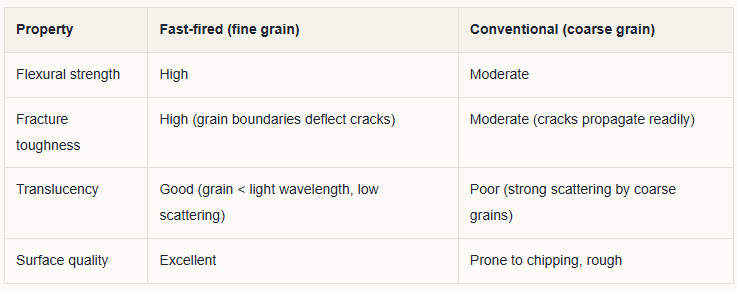
The value of fast firing lies not in producing a different material, but in reproducibly achieving—in far less time and at lower energy cost—the fine-grained, high-performance state that conventional firing struggles to obtain efficiently.
Fast-firing zirconia exemplifies the synergistic optimization of powder processing and sintering dynamics. Its speed stems not from a single compositional additive, but from a process design that decouples densification from grain growth, coupled with precise control of powder microstructure. A proper understanding of these principles enables correct material selection and the matching of block to firing protocol, so that the technology can deliver its full benefits in dental restoration and engineering manufacturing.

Dry & wet milling for zirconia, PMMA, wax with auto tool changer.
learn more
High-precision 3D scanning, AI calibration, full-arch accuracy.
learn more
40-min full sintering with 57% incisal translucency and 1050 MPa strength.
learn more
40-min cycle for 60 crowns, dual-layer crucible and 200°C/min heating.
learn more
High-speed LCD printer for guides, temporaries, models with 8K resolution.
learn more