


 中 文


Top 3 Materials for Dental 3D Printing
2024-12-28
2026-10-13
White zirconia is naturally highly translucent to opaque and has a relatively neutral white appearance. To achieve a more natural tooth-like shade, dental technicians can use internal staining to introduce color into the zirconia before final sintering.
But how does a staining liquid actually create a stable color inside white zirconia?
The process is more than simply applying a colored liquid to the surface. The final shade is related to the penetration and distribution of coloring species, the microstructure of presintered zirconia, the sintering process, and the way the material absorbs and scatters visible light.
Understanding this mechanism can help explain why staining technique, drying, and sintering conditions all affect the final shade.
Before discussing staining, it is important to understand why untreated zirconia appears white.
Presintered zirconia contains a porous structure composed of zirconia particles. When visible light enters the material, it interacts with different microstructural features, including particles, grain boundaries, and pores.
The difference in optical properties between these regions causes significant light scattering. When a broad range of visible wavelengths is scattered back toward the observer, the material appears white or near-white.
Therefore, the appearance of zirconia is determined not only by its chemical composition but also by its microstructure and optical behavior.
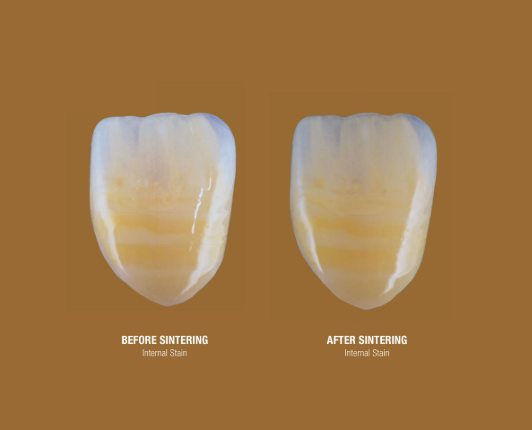
Internal staining is performed on presintered zirconia before final sintering.
The staining liquid contains coloring components designed to introduce a desired shade into the zirconia body. When the liquid is applied to the surface, it can penetrate the porous presintered structure through capillary action.
The basic process can be simplified as:
Staining liquid → penetration into pores → distribution of coloring species → drying → sintering → final color
The important point is that the staining liquid does not simply form a colored layer on the surface. Instead, its coloring components can become distributed within the body of the presintered zirconia.
This is why the technique is called internal staining.
Presintered zirconia has a much more open structure than fully sintered zirconia. Its interconnected pores allow liquids to move through the material.
Capillary forces can draw the staining liquid into these spaces. The penetration and distribution of the liquid depend on several factors, including:
Porosity and pore structure
Viscosity of the staining liquid
Application method
Staining time
Surface condition of the zirconia
Concentration of coloring components
A more uniform distribution generally helps produce a more consistent shade.
However, penetration alone does not determine the final color. The condition of the coloring components after drying and sintering is also important.
After staining, the zirconia is normally dried before sintering.
During drying, the liquid carrier gradually evaporates while the non-volatile coloring components remain within the zirconia structure.
This step is important because uneven drying can contribute to an uneven distribution of coloring components.
If moisture or solvent remains in the material when sintering begins, it can also affect how the coloring system behaves during heating.
Therefore, drying is not simply a waiting step. It is part of the overall staining process and helps prepare the restoration for controlled sintering.
Sintering is where the structure of zirconia changes significantly.
As the temperature increases:
Organic or volatile components in the staining system can evaporate or decompose.
Zirconia particles become more densely packed.
Porosity decreases.
Grain growth occurs.
The zirconia undergoes volumetric shrinkage.
Coloring species become incorporated or retained within the densified material.
The final appearance after sintering is therefore not necessarily identical to the appearance of the wet or freshly stained zirconia.
This is why the color of presintered zirconia should not be used as a direct prediction of the final shade.
From an optical perspective, the final color mainly results from the interaction between light absorption and light scattering.
Coloring species selectively absorb certain wavelengths of visible light.
When the absorption profile changes, the spectral composition of the light reflected from the zirconia also changes. The human eye then perceives this change as a different color.
At the same time, the zirconia microstructure continues to scatter light.
The final optical appearance therefore depends on both:
how much light is absorbed
and
how much light is scattered.
This explains why the same staining approach may produce different visual results depending on the zirconia's composition, microstructure, thickness, and sintering condition.
This is an important point that should be described carefully.
It is tempting to explain zirconia staining simply as metal ions entering the zirconia crystal lattice. However, this explanation is too general.
Depending on the staining system, coloring components may exist in different chemical states and distributions. Some may interact with the zirconia structure, while others may remain as finely distributed inorganic pigment or oxide phases.
Therefore, the final shade should be understood as the result of the chemical state and distribution of the coloring species together with the optical properties of the sintered zirconia.
In other words, there is not necessarily one single coloring mechanism for every staining system.
The staining liquid is only one part of the coloring process.
The final shade can also be affected by the characteristics of the zirconia and the processing conditions.
Differences in porosity and particle structure can affect how the staining liquid penetrates and distributes.
A higher or lower concentration of coloring components can change the amount of light absorbed and therefore influence the perceived shade.
Brushing, dipping, repeated application, or localized application can produce different distributions of coloring components.
Uneven drying may contribute to non-uniform coloring. Controlled drying helps maintain a more consistent distribution before sintering.
Temperature, heating rate, holding time, and the overall sintering program can influence densification, grain growth, shrinkage, and the final optical properties.
The thickness of zirconia affects the optical path of light through the material. The same stained material can therefore appear different at different thicknesses.
Internal staining is not simply a matter of choosing a color and applying it to zirconia.
Because the final shade is produced through several interconnected processes, small differences in application or processing can affect the result.
A controlled workflow should therefore consider:
The characteristics of the zirconia material
The type and concentration of staining system
The application method
Staining depth and distribution
Drying conditions
Sintering parameters
Restoration thickness and geometry
Consistency across these steps is particularly important when reproducing a specific shade.
The mechanism of white zirconia internal staining can be summarized as a continuous process:
White presintered zirconia
↓
Staining liquid penetrates the porous structure
↓
Coloring species become distributed within the zirconia body
↓
Drying removes the liquid carrier
↓
Sintering densifies the zirconia and stabilizes the final structure
↓
Coloring species modify light absorption
↓
The zirconia microstructure determines light scattering
↓
The combined optical response produces the final perceived color
This means that the final shade is not determined by the staining liquid alone. It is the result of the interaction between material structure, coloring chemistry, processing conditions, and optical behavior.
The color development of internally stained white zirconia is a multi-stage process rather than a simple surface-coloring phenomenon.
The staining liquid penetrates the porous presintered zirconia and distributes coloring components throughout the material. During drying and sintering, the carrier is removed, the zirconia becomes denser, and the coloring system undergoes changes that contribute to the final optical properties.
Ultimately, the perceived color is determined by the balance between light absorption by the coloring species and light scattering within the zirconia microstructure.
Understanding this mechanism also explains why staining concentration, application technique, drying, sintering conditions, zirconia microstructure, and restoration thickness can all influence the final shade.
For dental laboratories, controlling these variables is essential for achieving predictable and reproducible color results with internally stained white zirconia.

Dry & wet milling for zirconia, PMMA, wax with auto tool changer.
learn more
High-precision 3D scanning, AI calibration, full-arch accuracy.
learn more
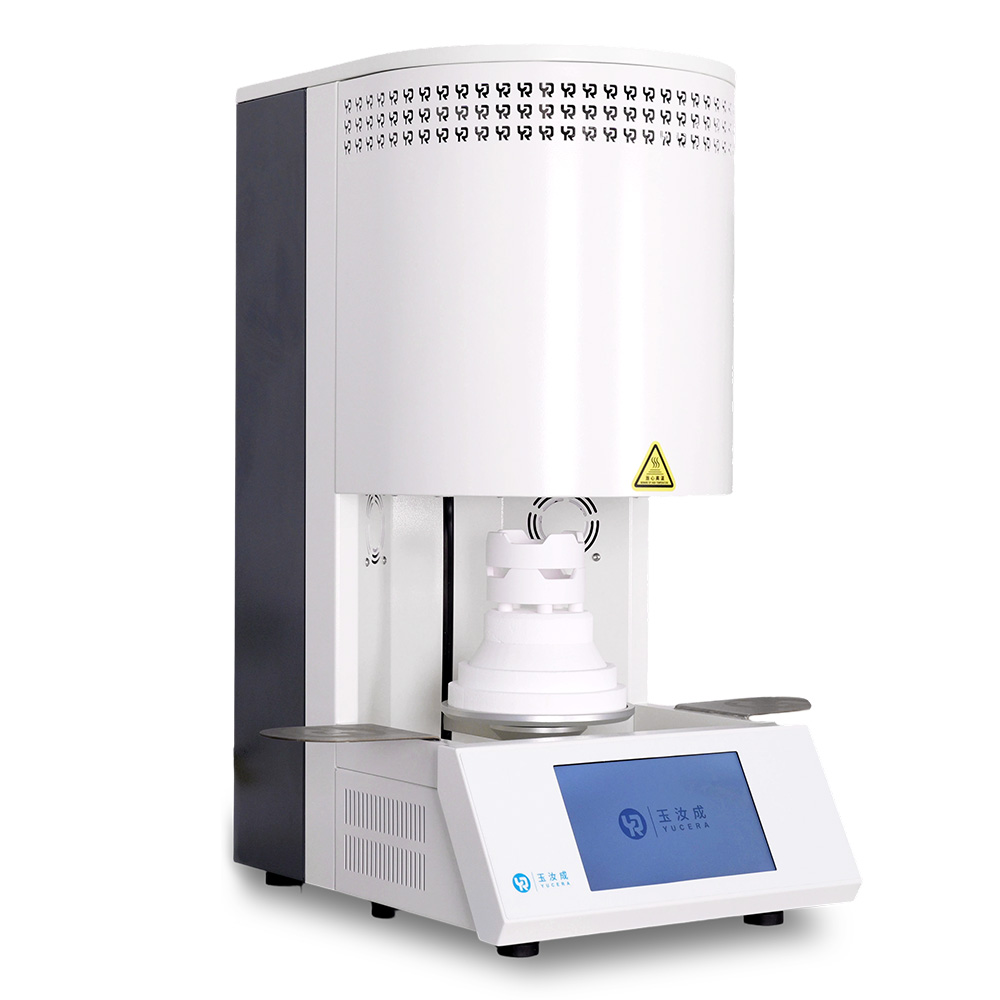
40-min full sintering with 57% incisal translucency and 1050 MPa strength.
learn more
40-min cycle for 60 crowns, dual-layer crucible and 200°C/min heating.
learn more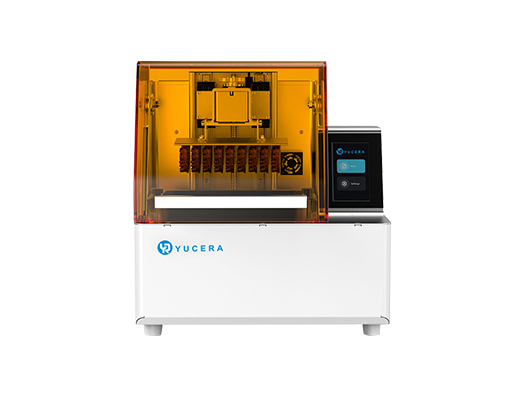
High-speed LCD printer for guides, temporaries, models with 8K resolution.
learn more


