中 文


History and Future Perspectives of Zirconia Block
2024-08-09
2026-10-19
Internal staining is widely used to adjust the shade of pre-sintered zirconia before sintering. However, zirconia coloring is more than simply adding pigment to a ceramic surface. The final color is related to the penetration of coloring ions, their chemical changes during heating, and their interaction with the zirconia matrix.
Understanding this mechanism helps explain why different coloring solutions, concentrations, application methods, and sintering conditions can produce different shades.
Most zirconia coloring solutions contain soluble compounds of transition metals or rare-earth elements. These compounds provide the ions responsible for developing color after sintering.
Common coloring elements include:
Iron (Fe) – commonly associated with yellow, reddish-brown, or brown tones
Chromium (Cr) – can contribute green tones and help modify shade
Manganese (Mn) – can contribute brown or reddish-brown tones
Vanadium (V) – can contribute yellow or other shade modifications
Praseodymium (Pr) – commonly used to produce yellow or yellow-green effects
Erbium (Er) – can contribute red or pink tones
Neodymium (Nd) – can modify specific optical and color characteristics
Cerium (Ce) – can contribute to optical properties and color adjustment
These elements may be introduced into the staining solution in the form of chlorides, nitrates, acetates, or other soluble salts.
Importantly, the salt itself is mainly a carrier for the coloring element. During heating, the original salt does not necessarily remain in its initial chemical form.
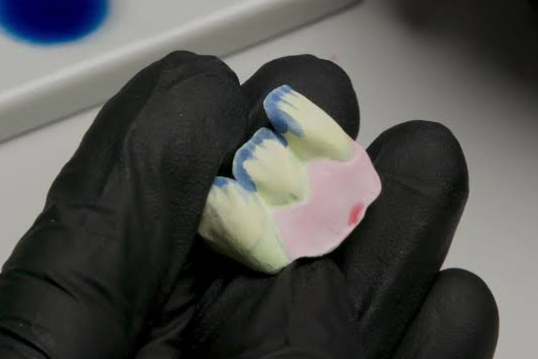
Pre-sintered zirconia has a relatively porous structure. Unlike fully sintered zirconia, it contains interconnected spaces between particles that allow liquid to penetrate.
When a coloring solution is applied, the liquid enters the zirconia through:
Capillary action
Wetting
Diffusion
Open pore networks
The coloring ions are therefore transported into the interior rather than remaining only on the surface.
The depth and distribution of penetration can be affected by several factors, including:
Zirconia porosity + liquid properties + ion concentration + application time + drying conditions
This is one reason why the same staining solution can produce different results when applied to different zirconia materials or under different processing conditions.
After staining, the zirconia must be dried before sintering. During drying, the liquid carrier is removed while the dissolved compounds remain within the porous structure.
As the temperature increases during sintering, the coloring compounds undergo thermal changes.
For example, a metal salt introduced into the staining solution may decompose or transform during heating, leaving metal-containing species or oxides within the zirconia matrix.
Therefore, the final coloring mechanism is not simply:
Colored liquid → colored zirconia
Instead, it is closer to:
Coloring solution → ion penetration → drying → thermal decomposition → formation of coloring species → interaction with zirconia → optical absorption → final color
This distinction is important when discussing the mechanism of internal staining.
The color we see depends on how the material interacts with visible light.
Many transition-metal ions contain partially filled d orbitals. When light reaches these ions, specific wavelengths can be absorbed because of electronic transitions between different energy levels.
The wavelengths that are not absorbed contribute to the light reflected or transmitted from the material, which determines its observed color.
For example, if a material absorbs more strongly in part of the blue-violet region, the remaining visible light can appear more yellow or orange.
Therefore:
Electronic structure → selective light absorption → reflected/transmitted spectrum → perceived color
This is one of the fundamental reasons different metal ions can produce different shades.
Yes, but the exact interaction depends on the element, concentration, processing conditions, and local chemical environment.
Some coloring species may remain primarily within pores or at grain boundaries, while others can interact more closely with the zirconia matrix.
Because zirconium is normally present as Zr⁴⁺, introducing ions with different charges can alter the local charge balance.
For example, when a lower-valence cation interacts with a zirconia lattice, oxygen vacancies may form as part of charge compensation.
This can be represented conceptually as:
Dopant ion → lattice substitution or interaction → charge imbalance → oxygen vacancies or other defects
These defects can modify the electronic structure and influence light absorption.
Therefore, the final color can depend not only on the coloring element itself, but also on its local chemical environment inside the zirconia.
A coloring ion does not always produce exactly the same color in every zirconia system.
Its optical behavior can be affected by:
Oxidation state
Ion concentration
Coordination environment
Distribution within the zirconia
Oxygen vacancies
Zirconia phase composition
Grain structure
Sintering temperature
Sintering atmosphere
Final density and translucency
For example, iron in different oxidation states can have different optical characteristics. Similarly, the same ion can behave differently depending on whether it is located within the zirconia lattice, near grain boundaries, or in another local chemical environment.
This is why internal staining should be considered a material–coloring system, rather than simply a pigmenting process.
Coloring elements can also be broadly divided into transition metals and rare-earth elements.
Elements such as Fe, Cr, Mn, and V can produce strong optical effects through electronic transitions associated with their partially filled d orbitals.
They are often used to establish or modify basic shade characteristics.
Elements such as Pr, Er, Nd, Tb, and Ce have different electronic structures. Their 4f electrons are relatively shielded by outer electron shells, producing characteristic absorption behavior.
As a result, rare-earth ions can be useful not only for shade adjustment but also for controlling specific optical characteristics, including certain fluorescence-related effects.
The actual color obtained depends on the concentration, oxidation state, chemical environment, and combination of different coloring elements.
For internal staining to produce a consistent shade, the coloring species need to be distributed as uniformly as possible throughout the intended staining area.
Uneven penetration can create differences between:
The surface and interior
Cervical and incisal regions
Different parts of the restoration
Different thicknesses of zirconia
After sintering, these differences may become visible as uneven color or shade transitions.
Therefore, consistent staining depends on more than simply choosing the correct coloring solution. The condition of the zirconia, application technique, drying process, and sintering schedule all contribute to the final optical result.
The mechanism of zirconia coloring can be summarized in five stages:
1. Penetration
Coloring ions enter the porous pre-sintered zirconia.
2. Distribution
The ions are distributed through the pore network according to the material structure and staining conditions.
3. Thermal transformation
Drying and sintering cause the original soluble compounds to decompose or transform.
4. Interaction with the zirconia matrix
Coloring species interact with the zirconia structure, local coordination environment, and defects.
5. Light absorption
The resulting electronic structure selectively absorbs certain wavelengths of visible light, producing the final perceived color.
Therefore, internal staining can be understood as:
Coloring ions + zirconia microstructure + thermal treatment + optical absorption = final shade
The color of internally stained zirconia is not simply the result of depositing a colored substance onto the surface. It is the result of a series of chemical, structural, and optical processes.
Coloring ions such as Fe, Cr, Mn, V, Pr, Er, Nd, and Ce can penetrate the porous pre-sintered zirconia. During drying and sintering, their chemical forms can change, and some species may interact with the zirconia matrix and influence local defects such as oxygen vacancies.
These changes affect how the material absorbs visible light, ultimately determining the color perceived by the human eye.
Understanding this mechanism also explains why ion type, concentration, penetration, drying, sintering conditions, and zirconia microstructure all matter when controlling the final shade.
Internal staining is therefore best understood not as simple pigmentation, but as a chemical and optical process occurring within the zirconia material.

Dry & wet milling for zirconia, PMMA, wax with auto tool changer.
learn more
High-precision 3D scanning, AI calibration, full-arch accuracy.
learn more
40-min full sintering with 57% incisal translucency and 1050 MPa strength.
learn more
40-min cycle for 60 crowns, dual-layer crucible and 200°C/min heating.
learn more
High-speed LCD printer for guides, temporaries, models with 8K resolution.
learn more